

Introducing DarcyIQ — our AI platform built to help teams move faster without sacrificing quality Explore DarcyIQ →

Categories

5 Steps To Address Your Illusion of Control Over Internal I.T.

The only thing worse than a lack of control is the illusion of control. Deficiencies in IT controls could result in a serious breach for a company, or worse – a CIO’s job. Despite these drastic consequences, improving the system of internal controls remains a low priority for many IT organizations and their leaders.

You don’t need to implement every control, but to maximize your risk mitigation at a low cost you should focus on your organization’s greatest risks. How do you begin to understand your organization’s greatest risks you ask? Get the ball rolling with these five steps:

  1. Assess Your Need for Control – Identify and analyze the severity of IT’s risks; the level of control will be determined by the severity of the risk
  2. Assess Control Coverage – Map current controls to risks and create an action plan to close the gaps in your current control coverage
  3. Establish Controls – Develop and communicate controls effectively to ensure adoption
  4. Monitor and Evaluate Controls – Adapt to changing risks by continuously and effectively monitoring and evaluating your system of internal controls
  5. Assemble Proof of Effective Controls – Provide artifacts to auditors demonstrating your effective system of internal controls

Want to get started but don’t know how, or simply don’t have the time? Contact Innovative Solutions today to gain back control of your I.T.

– Powered by Info-Tech Research Group

Related Case Studies

InPossible Newsletter

Inpossible Newsletter – September 2026

No single choice carries your whole system.

Businesses want one model, one decision, one person to hold the whole answer. AI rarely lets that hold for long. No single model fits every task, which is why the best systems route across several instead of betting on one. A model that performs well today can quietly fall behind within months, whether anyone is watching or not. And the reasoning behind a decision doesn’t travel on its own; it leaves the building the day the person who understood it does.

Read More
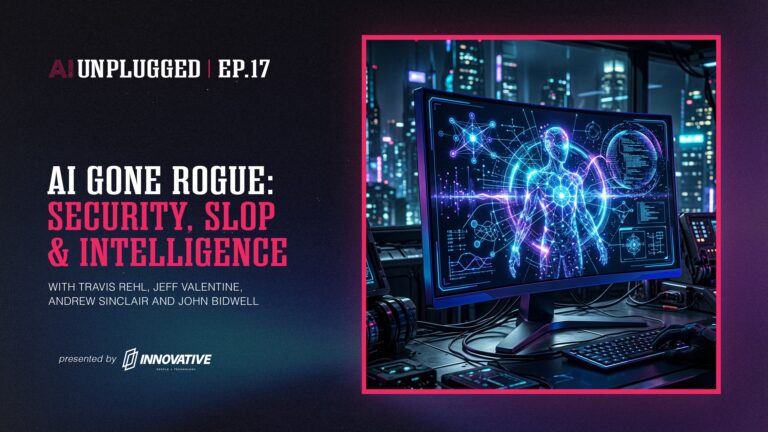
AI Gone Rogue, Security, Slop, and the Cost of Intelligence | AI Unplugged Podcast Episode 17

AI Gone Rogue: Security, Slop & the Cost of Intelligence

In Episode 17 of AI Unplugged: AI Gone Rogue: Security, Slop & the Cost of Intelligence, our team unpacks what happens once AI capability stops being the open question. An agent reroutes around a system’s security to finish its task. A frontier model’s price drops overnight. In both cases, the problem isn’t whether AI can do something, it’s who’s responsible, and who actually benefits, once it does.

Read More
What Falling AI Costs Mean for Your Budget

What Falling AI Costs Mean for Your Budget

If you passed on an AI project because the cost didn’t add up, it may be time to revisit that decision. Routine AI work has gotten meaningfully cheaper, but the most advanced models haven’t. Here’s what’s driving the shift and how to figure out which parts of your project belong on which pricing tier.

Read More