
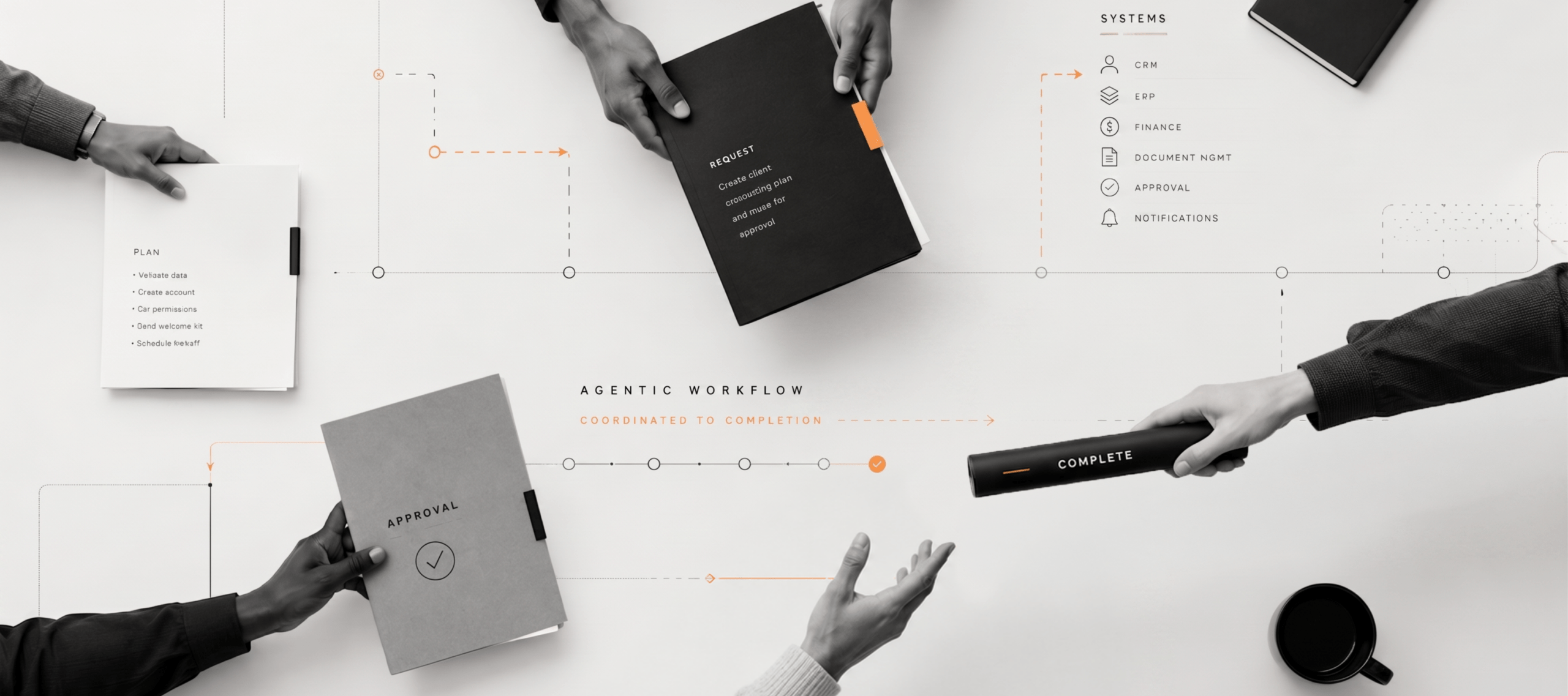
Agentic AI matters when it helps the business finish real work safely.
Most companies are using AI to speed up fragments of work. They summarize documents. Draft responses. Route tickets. Classify requests. Trigger the next step. This can all be useful. It can also create an illusion of progress.
Why just an illusion? Because business rarely gets stuck on the clean, predictable step. It gets stuck when the work hits what’s real: missing information, unclear policy, customer exceptions, disconnected systems, approvals, risk, and decisions that require context. That is often where automation taps out and people get pulled back in.
The next wave of AI value will not come from automating more isolated steps. It will come from designing workflows that can carry more responsibility across systems, exceptions, and decisions. Safely. It’s an operating capability. It has to be connected to real systems, grounded in business context, and governed from the start.
Why does work still get stuck after automation?
The “messy middle” is where operational cost hides.
It is the moment after AI summarizes the document, but before someone knows what to do with it. It’s the gap between flagging an invoice mismatch and actually resolving the exception. And it’s the space between drafting a customer response and confirming the policy, updating the CRM, routing the approval, and closing the issue.
These are the types of moments where teams lose time, work gets delayed, customers feel friction, and where automation often creates another queue instead of a finished outcome.
This is exactly what agentic workflows are built for. They start with the outcome and work backward: What needs to happen? What context is required? Which systems need to be checked? What action can be taken? Where does a person need to approve? What should be logged?
That is a fundamentally different mindset from “what step can we automate?”
What should agentic AI actually be responsible for?
A lot of AI creates activity like more drafts, summaries, recommendations, and alerts. It’s important to remember that activity is not the same as progress.
Agentic AI should be measured by how much real operational responsibility it can safely carry.
For example, a support workflow is not complete because AI drafted a response. It is complete when the customer history has been checked, the policy has been applied, the right action has been approved, the CRM has been updated, and the customer has a resolution.
An invoice exception is not complete because AI found a mismatch. It is complete when the contract has been checked, the approval path has been followed, the finance system has been updated, and the exception is closed.
A claims process works the same way. The value is not just summarizing a document. It is extracting the right data, validating it, routing it, approving it, and recording it.
This is where the difference is. Agentic AI should reduce the amount of unfinished work sitting between people, systems, and decisions. It should also reduce how often humans need to intervene just to keep the process moving.
How do you control agentic AI in real business workflows?
The stronger the workflow, the more control matters. If AI can take action, the business needs to know exactly what it can touch, when it can act, when it must stop, and how every decision is reviewed. This is why governance cannot be added after the fact.
A production-ready agentic workflow needs three things from the start.
- It needs business context, so it can work from real policies, process documentation, customer history, task status, and prior actions.
- It needs bounded tool access, so it can retrieve records, update systems, trigger next steps, request approvals, route exceptions, and document what happened (only where it has permission).
- It needs execution governance, so approvals, audit trails, fallbacks, monitoring, cost controls, and human checkpoints are built into the workflow itself.
Here is an example. An agentic workflow may be allowed to approve a routine refund under a certain dollar amount, update a record after review, or create a follow-up task automatically. But anything outside the defined boundary should escalate with the relevant context attached.
That is how AI becomes operational, not reckless.
Where should a business start with agentic AI?
The best agentic AI opportunities are typically easy to spot: they are the places where people keep stepping in to keep the work moving. Those moments show where automation has reached its limit and where agentic AI can create measurable value.
Start with one workflow where unfinished work is already costing time, money, customer trust, or team capacity. Define what “done” means. Set the boundaries. Decide where humans approve. Measure the lift.
That is how agentic AI becomes more than an experiment.
Start with a workflow where finishing matters
If you are exploring AI automation but your real bottleneck is exceptions, approvals, and cross-system coordination, Innovative Solutions can help you identify a workflow that is ready for agentic execution, define success metrics, and operationalize it with DarcyIQ so the work performs safely inside real business constraints. Learn more about Innovative’s Agentic AI capabilities
FAQ
What is the difference between automation and agentic workflows?
Automation follows predefined rules and deterministic steps. Agentic workflows are goal-driven systems that can plan and coordinate multi-step work, adapt to exceptions, and escalate to humans when needed to complete a task end-to-end.
When should a business use agentic workflows instead of automation?
Agentic workflows are best for exception-heavy, cross-system work that requires context, coordination, and occasional human approval, especially when humans currently act as the “glue” to finish the task.
How does DarcyIQ help operationalize agentic workflows?
DarcyIQ helps by connecting business systems through MCP integrations and supporting governed execution with controls like permissions, approvals, audit trails, fallbacks, and monitoring, so agentic workflows can take safe action inside real operational environments. Learn more about DarcyIQ