
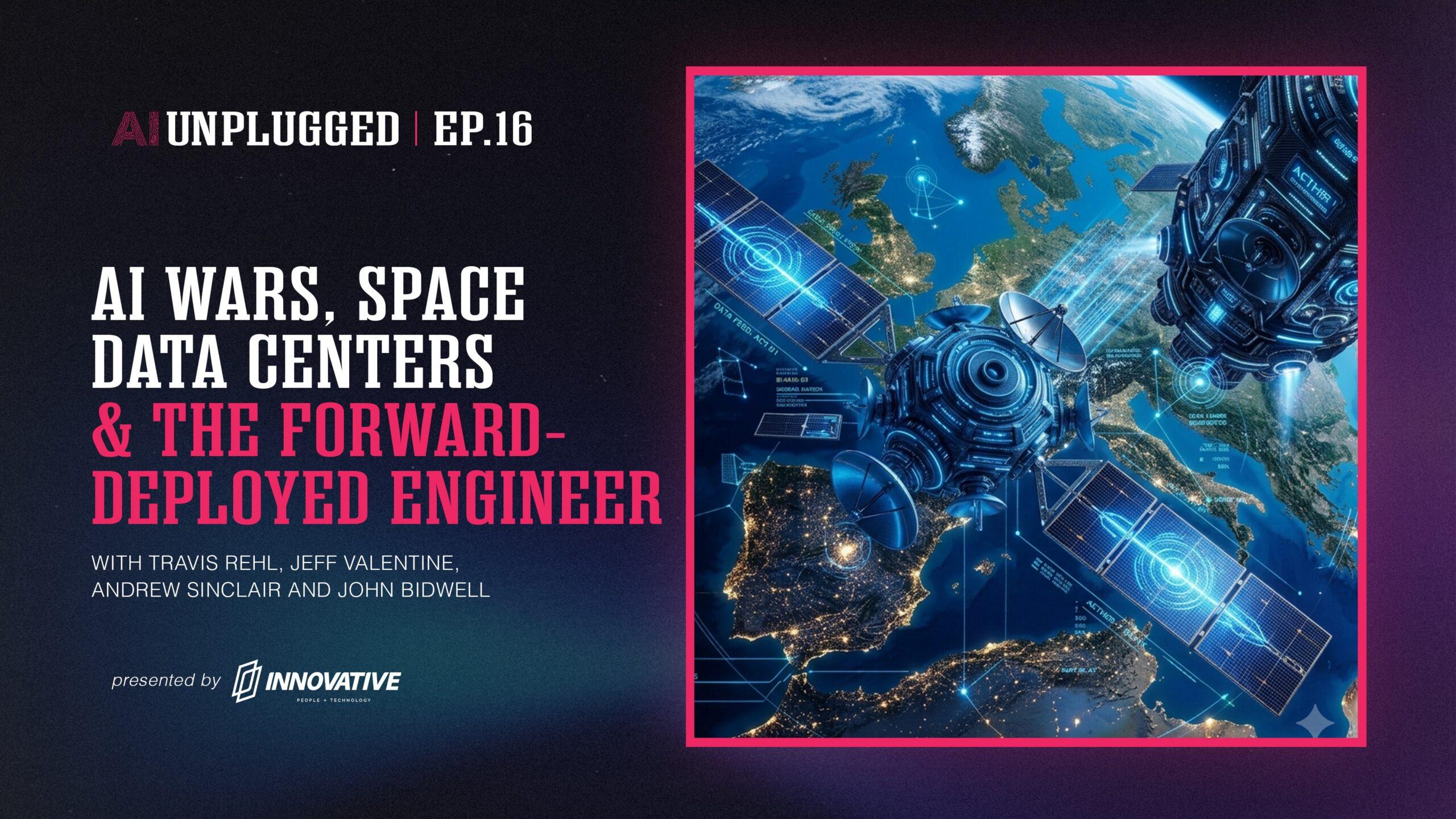
AI Uplugged Podcast Episode 16
The AI arms race is not over. It is just changing what it takes to win.
After a stretch that felt like a lull, new models are landing again, and each one arrives with a bigger claim than the last: Fable, GPT’s Soul 5.6, Grok 4.5, even Meta signaling a return with Muse and Spark. For a while, the story was simple: whoever built the smartest model would win.
In Episode 16 of AI Unplugged: AI Wars, Space Data Centers & the Forward-Deployed Engineer, the conversation moves past that story. The sharper question isn’t which model scores highest anymore. It’s which company can turn model capability into something that runs, scales, and holds up in the real world.
As the top models converge on similar benchmarks, the companies that win won’t be the ones with the newest release. They’ll be the ones that know when to use it, how to combine it with everything else, and whether their organization can move at the speed the technology now allows.
Intelligence is not the differentiator anymore
The clearest sign the AI race has changed: everyone is suddenly competing on price. Grok 4.5 launched on Cursor at what the team describes as equivalent to Opus 4.8, at half the cost. GPT’s Soul 5.6 is positioning itself as meaningfully cheaper than Fable while claiming to beat it on certain benchmarks. That’s a different competition than the one the industry was running a year ago, when the entire conversation was intelligence, intelligence, intelligence.
It’s also forcing a harder question inside the businesses buying these models: how much does the last few points of performance actually cost? Innovative ran its own test, moving one product from the highest reasoning tier to a mid-tier model.
The result: a 1-2% drop in performance for a 40% reduction in cost, a trade the team called worth taking “all day.” As John Bidwell put it, chasing the newest model for every task is “like high-end audio equipment. You’re going to get to that point where you’re going to pay a lot of money for just a little bit better sound.”
The best AI stack is plural
If intelligence alone isn’t the differentiator, the next question is how businesses deploy the models they have. The episode’s answer: not with just one.
Anthropic’s own positioning captures the shift: cheaper models can do the building while Fable does the planning, similar to a senior architect handing off the master plan to a team of skilled builders. Innovative already runs this way internally, front-ending multiple models and routing work to whichever fits the task, without asking the customer to choose. Sometimes the model itself makes that call, spinning up cheaper sub-agents for work that doesn’t need premium horsepower.
The side effect: tokens and model choice matter less to the end user, and deploying across multiple providers means a GPU shortage at one doesn’t take down the whole system. Innovative’s own DRC pricing, unlimited usage charged per user, pushes the same discipline from a different angle: absorbing the cost of every model call forces more deliberate choices about which model handles which job.
Ambition still has to survive physics
Not every problem in this episode is software. Some of it is about where the hardware actually lives. As AI infrastructure costs climb, the conversation has turned toward more exotic real estate: space and the ocean. Elon Musk is reportedly pursuing the space version, Sam Altman has reportedly pushed back on it, and Microsoft, per Satya Nadella, is looking at the ocean instead.
The pushback in the episode isn’t that these ideas are impossible. It’s that physical reality doesn’t disappear because the location changes. Hardware fails constantly at scale, and someone has to physically swap out failed components, far harder once equipment is orbiting Earth or sitting on the seafloor. Power draw is also less predictable than people assume; as Jeff Valentine put it, a training run’s pull on the grid “might double in a second.” Add in a GPU market that’s already scarce and already aging out fast, and locking that hardware into a satellite or a pod for years raises a real risk it’s obsolete before it delivers a return. None of that settles whether these data centers get built. It just means the maintenance and the economics don’t go away because the location does.
AI speed is outrunning enterprise process
Assume the model problem and the infrastructure problem both get solved. There’s still a third bottleneck, and it isn’t technical at all: the organization itself.
AI has compressed development timelines dramatically. But faster software doesn’t mean a faster business if the approval chain around that software hasn’t changed. An enterprise with four layers of sign-off wasn’t built to move at the speed AI now allows, and reworking that structure is a much harder problem than reworking the tech stack.
That creates an opening. Smaller businesses, without the multi-layered approval process, may be able to close the gap on much larger competitors simply by moving faster. Carried far enough, that could shrink what “enterprise” even means, as the businesses able to compete at scale become the ones that stay lean enough to keep up.
The human-versus-machine math just got more complicated
Two years ago, the question was straightforward: can a person be replaced by an agent, and is it cheaper? That math has moved on. In some cases, agent-based work now costs roughly the same as human labor, which raises a different question: if cost is similar, what’s actually being compared?
One answer is reliability, not cost. A model that one-shots a task correctly every time may cost more per attempt, but a person may fail and retry before landing on the right answer, something per-token cost doesn’t capture. Another answer is that the comparison was never human versus machine to begin with. It may be speed to market.
Implementation is becoming the real product
All of this points to the same conclusion: the model is not where most of the value gets created. What happens around the model is.
That’s the logic behind the forward-deployed engineer model the team has been rolling out, a role Palantir helped popularize. Instead of handing over a tool and walking away, an FDE sits inside the customer’s business, learns the actual problem, and stays hands-on through implementation and training.
Innovative’s early results back this up: since rolling out forward-deployed services, the team has seen more interest than expected, on a simple insight, most AI vendors are good at building solutions and mediocre at making sure anyone adopts them. There’s a natural ceiling here too. Small businesses often can’t afford embedded staff and lean toward a single in-house champion instead; mid-market and up can absorb the FDE model directly.
The path forward
A few concrete habits fall out of this episode. Stop defaulting to the most expensive model; test whether a mid-tier option gets you 95% of the result for a fraction of the cost. Build a deliberate multi-model stack instead of betting on one provider. Pressure-test any infrastructure bet against how fast the technology inside it will age, not how cheap the real estate looks. Look honestly at your own approval process; if it’s slower than the AI-enabled work moving through it, the process is now the bottleneck. And invest in enablement, not just deployment, since a powerful tool nobody knows how to use produces no return at all.
The AI arms race is not over. It is just changing what it takes to win. And the companies that end up ahead may not be the ones with access to the smartest model. They may be the ones that figured out, faster than everyone else, how to actually put it to work.