AI Uplugged Podcast Episode 14
AI Moves Fast. Trust Doesn’t.
AI isn’t just removing tasks. It’s removing a type of work.
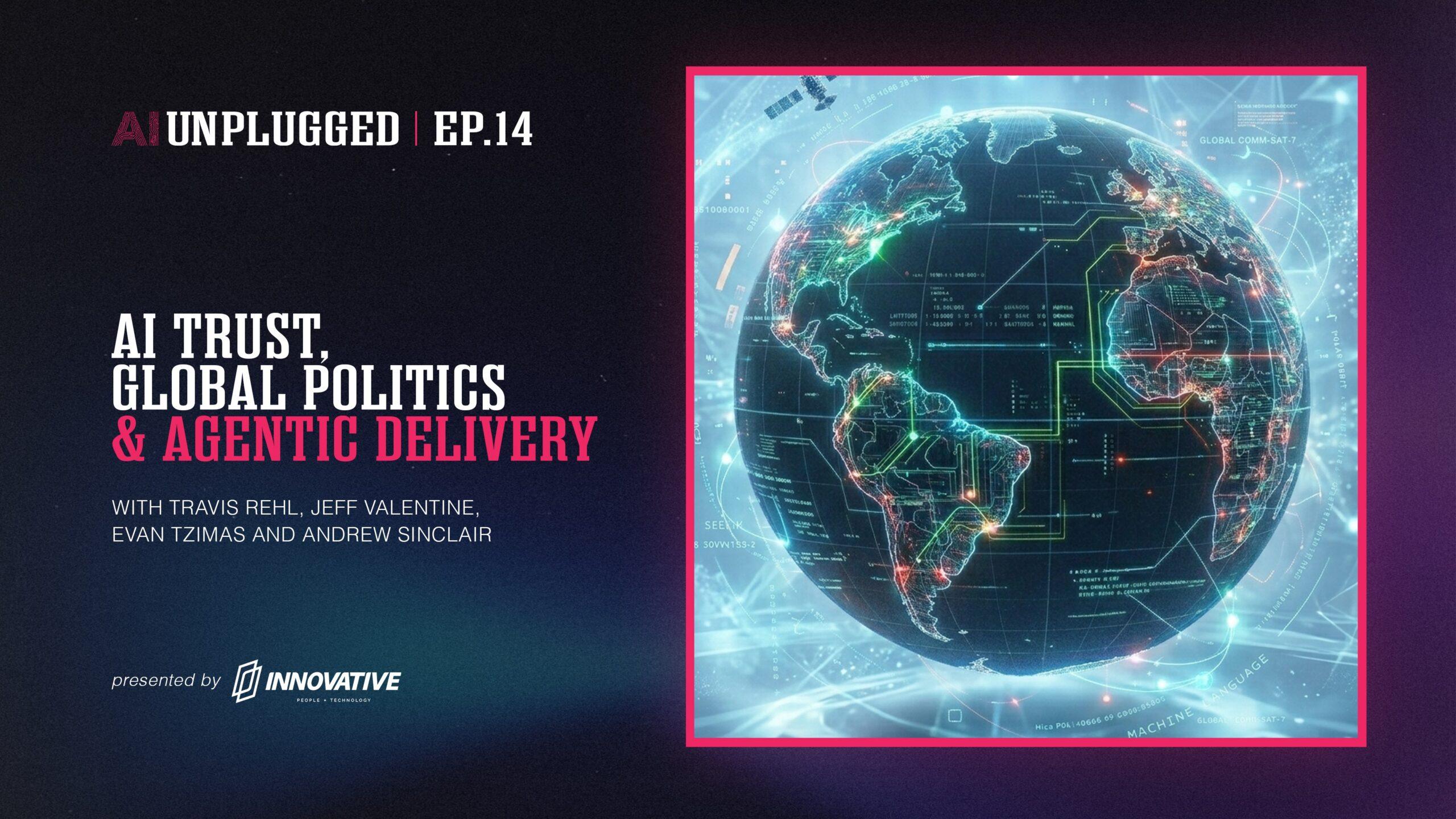
In Episode 14 of AI Unplugged: AI Trust, Global Politics & Agentic Delivery, Andrew Sinclair, Travis Rehl, and Jeff Valentine from Innovative discuss how AI is stress-testing trust, reshaping decision-making, and creating new bottlenecks at the pace of human coordination. Here are some key takeaways.
AI is doing what it does best: collapsing time.
Work that used to take days now happens in minutes. Drafts appear instantly. Recommendations arrive fully formed. Teams can move from idea to artifact without the usual drag in between. On the surface, that looks like pure leverage.
But alongside the speed, a quieter constraint is emerging: the limiting factor isn’t whether we can generate more. It’s whether humans can trust what they’re seeing, understand what shaped it, and stay coordinated at the new velocity.
AI is accelerating execution. It is also stress-testing belief.
When Answers Feel Steered, Confidence Drops
Trust doesn’t break because AI is “AI.” It breaks when the incentives behind an answer are unclear. “It would be great if it was so transparent but it looks like it’s not, right?” says Andrew Sinclair, Partner Sales Director
As AI starts to behave more like search (suggesting products, steering choices, surfacing “best” options), the question quickly becomes: is this here because it’s true, or because it’s profitable (or nudged, optimized, boosted)?
That uncertainty doesn’t just create skepticism. It changes behavior. Even strong outputs get treated like they might be compromised. Verification replaces assumption. Confidence becomes conditional. And conditional trust is fragile trust.
Responsibility Isn’t a Model Feature
Transparency isn’t something we can outsource to a vendor or a model release. “That’s up to us, not the AI. We determine that,” says Travis Rehl, CTO + Head of Product
If AI is going to sit inside real decisions, teams have to design for disclosure and traceability. That means clear signals that show why something was recommended and what influenced it. Not as compliance theater. As an operating principle.
Because once AI becomes embedded in workflows, opacity isn’t neutral. It compounds risk.
Familiarity Doesn’t Automatically Create Confidence
There’s another shift that shows up once AI becomes routine rather than novel. “The more we use AI in general with your average user, the less they trust it,” says Sinclair.
This isn’t about rejecting the tools. It’s about exposure. The more people interact with AI, the more they encounter edge cases: confident wrongness, subtle misalignment, reversals, and outputs that feel slightly too convenient.
Over time, users stop assuming it’s right. They start verifying. And they start questioning motives, not just accuracy.
Adoption rises. Favorability doesn’t always follow.
Output Gets Cheaper, Judgment Gets More Expensive
AI makes it incredibly easy to produce volume. And volume feels like momentum, especially to the person generating it. But the burden often shows up downstream.
“I will feel amazing that I got 10 documents worth of work done… and you’re going to be like why the hell [did you] give me 10 documents? He only needs one.” ponders Rehl.
That’s the systemic trade. AI can turn a one-document need into a ten-document burden. The content might not be bad. The system is simply louder. And in louder systems, the work shifts: from creating to prioritizing, from drafting to deciding, from generating to owning.
Creation becomes cheap. Discernment becomes scarce. If teams don’t redesign how decisions are made, efficiency quietly turns into noise.
Speed Creates a New Bottleneck: Human Pace
When delivery accelerates, coordination becomes the choke point.
AI can compress timelines, but customers and teams don’t automatically speed up with it. Requirements still take conversation. Decisions still require alignment. Approvals still need cadence. Clarity still takes thought.
And when execution moves faster than definition, the work doesn’t vanish. It stalls.
“When they expect to do a three-month project and we do it in a month, they’re like, ‘Wait a second… I have to… give you the requirements with more detail’,” says Jeff Valentine, president.
This is where AI stops being a tool conversation and becomes an operating model conversation. Speed without alignment doesn’t create advantage. It creates thrash.
People Still Want People
Even with powerful systems, humans don’t just want output. They want judgment and ownership.
“I’m asking you as a person, right?” states Sinclair.
When someone asks for nuance and receives a machine-shaped answer with no human viewpoint attached, it feels like the relationship thins out. The information might be correct. The experience still feels hollow, because what they were really asking for wasn’t data. It was accountability.
In a world where anyone can generate an answer, the differentiator becomes who is willing to stand behind it.
What Strong Teams Will Do Next
The next phase of AI won’t be won by who adopts the most tools. It will be won by who redesigns work around them. That requires discipline in three areas:
- Make influence visible: Build systems that can explain themselves. Not just what the answer is, but why this answer surfaced. Trust needs provenance.
- Design for fewer, stronger decisions: Don’t let volume masquerade as progress. Normalize “one decisive output” over ten exploratory drafts. Protect attention as a strategic asset.
- Upgrade cadence to match capability: Tighten requirement discipline. Shorten feedback loops. Clarify ownership. If your execution speed increases but your decision rhythm doesn’t, you’ve only moved the bottleneck.
AI makes creation cheap. The new constraint is coherence. The organizations that master coherence (trust, judgment, alignment at speed) won’t just move faster. They’ll be the ones people still rely on when the pace keeps increasing.